
Liberty County Criminal Court Cases
Liberty County divides criminal cases by court level. Circuit Court hears felony prosecutions. County Court handles misdemeanors and criminal traffic. Both sit within Florida's Second Judicial Circuit, and both use the Liberty County Clerk of Circuit Court and County Comptroller as the file custodian. The clerk receives the prosecutor's charging paper, records motions and hearings, preserves orders, and maintains the judgment and sentence. The sheriff may document the arrest, but that law-enforcement file does not replace the court docket.
Bristol is the county seat and the only incorporated municipality. There is no supported separate Bristol police or municipal criminal-court portal. That makes the county clerk the central route for filed local prosecutions. Case numbers, court division, filing date, and the State of Florida party caption help distinguish one Liberty County court case from another. A name match by itself is not enough when people share similar names.
Two Liberty Criminal Court Levels
The charge level determines where the case begins. A felony is filed in Liberty Circuit Court, while a misdemeanor or criminal traffic matter generally belongs in Liberty County Court. The Second Judicial Circuit's Liberty courthouse page confirms the local court setting. It is useful when the Clerk search result names a division but the reader needs to identify the actual court.
The Clerk's payment page separately lists felony, misdemeanor, Florida Fish and Wildlife Conservation Commission, and traffic payment paths. A payment screen is not a complete docket. It may show a balance without explaining the plea, adjudication, sentence terms, or later order. Read the judgment and sentence before treating a financial entry as the case outcome.
The official Second Judicial Circuit view also shows the Liberty courthouse. This source image provides context for where local criminal files are maintained.
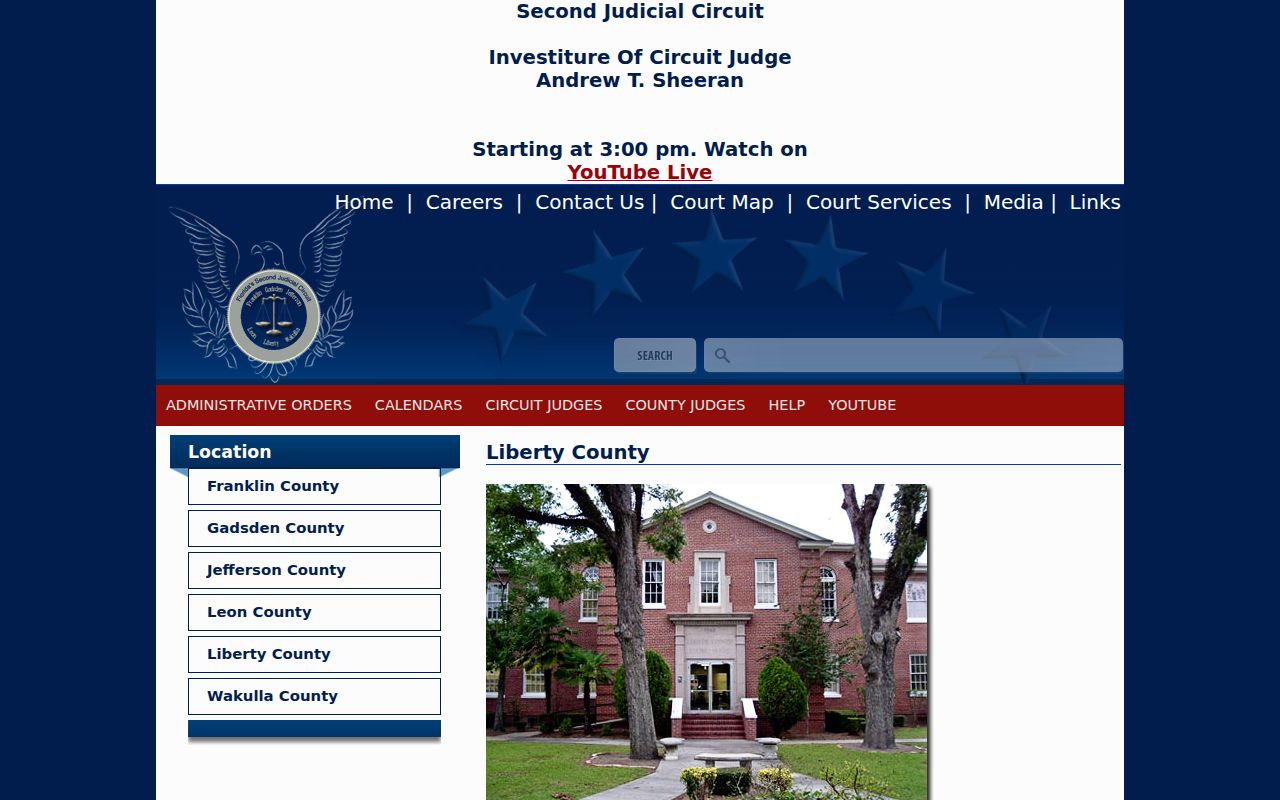
The courthouse image reinforces the county's centralized record system: court files are not spread among several city counters.
Searching Liberty County Case Records
The official Liberty Clerk Records Search is the first remote channel. Its gateway requires completion of a registration agreement before online records can be viewed. The public gateway did not expose stable pre-login form controls, so readers should follow the live labels rather than assume that another Florida county's search fields work here.
- Open the Clerk's records-search gateway and complete the current registration agreement.
- Use the exact case number when known. Otherwise, search the party name using the spelling supported by the live form.
- Confirm the court level, filing date, case type, and party caption before selecting a result.
- Read docket entries in date order and open only those images permitted by the access system.
- Ask the Clerk for the named document or a certified disposition when metadata alone does not answer the question.
| Search item | Type | Access | Liberty County use |
|---|---|---|---|
| Registration agreement | Account or agreement | Required for remote viewing | Complete the current gateway terms |
| Case number | Text | Portal-dependent | Best discriminator; preserve punctuation |
| Party name | Text | Portal-dependent | Compare case metadata, not just the name |
| Filing year or case type | Live control | Verify after login | Narrows similar results if offered |
When an event is very recent, a booking may exist before the State Attorney files a case. Check the Clerk again after filing. Never restate the jail's initial charge as the final court charge.
The source view of the Liberty criminal case gateway shows why registration is part of the search process.
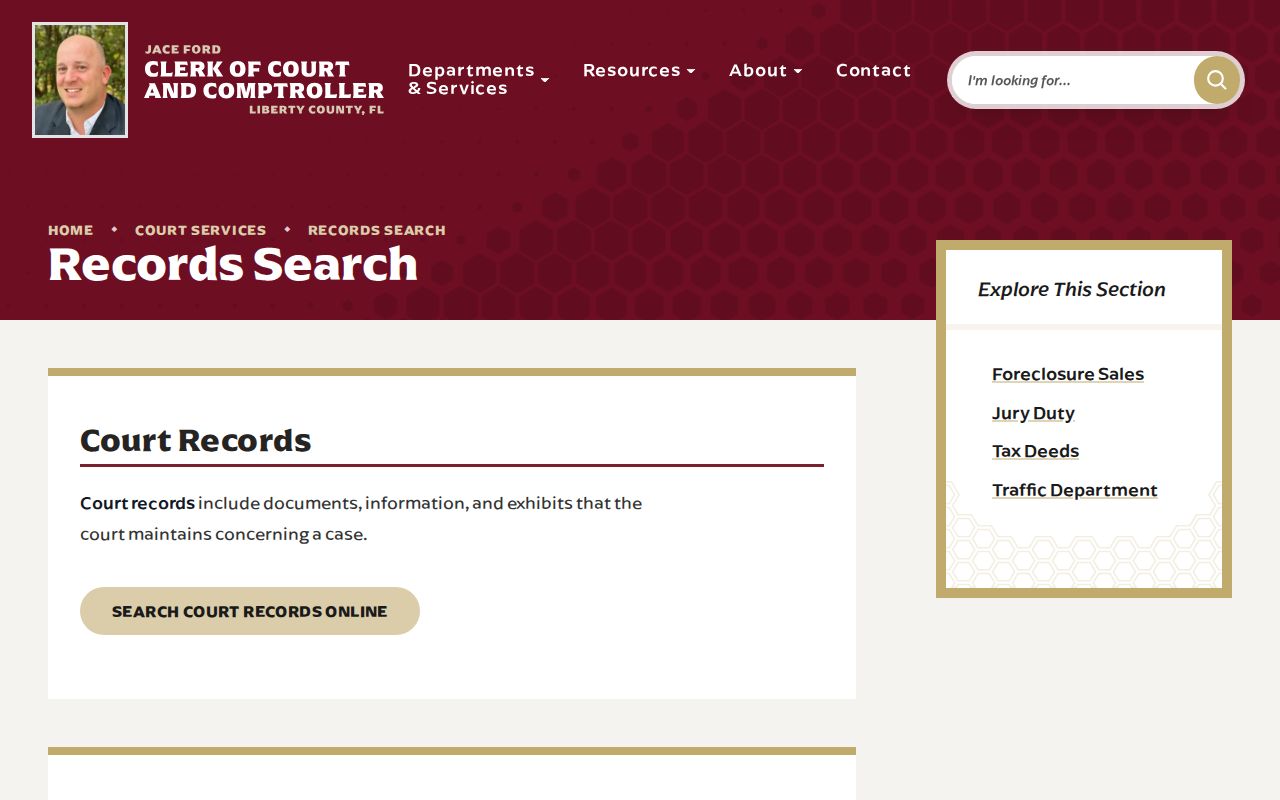
This gateway is the county-specific online entry point, but the Clerk remains the fallback for missing images and older records.
When Liberty Case Images Stop
A docket index and an image are not the same form of access. Florida judicial-branch rules can permit a public docket entry while limiting the document image shown online. An older filing may not have been imaged. A protected identifier may require redaction. Sealed, expunged, juvenile, victim-protected, or confidential material may not appear at all. A blank image link therefore does not prove that no paper record exists.
Call the Clerk at (850) 643-2215 or visit 10818 NW State Road 20, Bristol, Florida 32321, Monday through Friday from 8:00 a.m. to 5:00 p.m. Give the case number, docket title, filing date, and preferred delivery method. Ask whether an uncertified copy is sufficient or a certified copy is needed. Current copy and certification charges were not published on the criminal page, so request a quote before ordering a large file.
Note: Remote absence is not proof of sealing, expunction, dismissal, or the absence of a Liberty County court case.
Inside a Liberty County Case File
A criminal case file is a timeline of the prosecution. It may start with a complaint or information, then add pleas, motions, hearing notices, orders, and the final judgment. Each count must be read separately because charges can be amended or dismissed at different times. The final court disposition carries more weight than a booking label when describing the judicial result.
| Case header | Case number, court or division, filing date, case type, and status. |
|---|---|
| Parties | State of Florida, defendant, and attorneys of record where public. |
| Filed charges | Count, statute, degree, description, and amended status. |
| Docket events | Filings, arraignment, pleas, motions, notices, hearings, and orders. |
| Disposition | Dismissal, nolle prosequi, acquittal, plea, adjudication, or judgment by count. |
| Sentence | Custody, probation or community control, fines, costs, credit, and conditions. |
An FDLE criminal-history response may contain reported arrest cycles and dispositions, but the Liberty Clerk file proves what the local court entered. If a statewide response lacks an outcome, a certified disposition is the best local document for the subject to use in FDLE's personal-review and correction process.
Read Liberty Dockets as Timelines
Docket labels describe events, not always outcomes. “Information filed” means the prosecutor filed charging counts. It is not a conviction. Arraignment is the stage when charges and a plea are addressed. “Nolle prosequi” means the prosecutor declined to continue that count. A dismissal or acquittal resolves a filed count without a conviction, but the separate arrest record may remain unless lawfully sealed or expunged.
- Adjudication withheld
- The court withholds a formal adjudication of guilt. It is not the same as dismissal and can still have legal effects.
- Capias
- A court command to take a person into custody, often tied to a failure to appear or another case event.
- Closed
- An administrative case status. It does not guarantee that every financial or supervision duty has ended.
- Sentence
- The order stating sanctions and terms, which may include custody, supervision, costs, or credit for time served.
A payment balance is only one part of a sentence. Review the order and any later modification, revocation, or satisfaction entry. When an abbreviation is unclear, ask the Liberty Clerk. Do not import a glossary from another county's software.
The official Liberty Clerk payment source illustrates the separate case categories available for online payment.
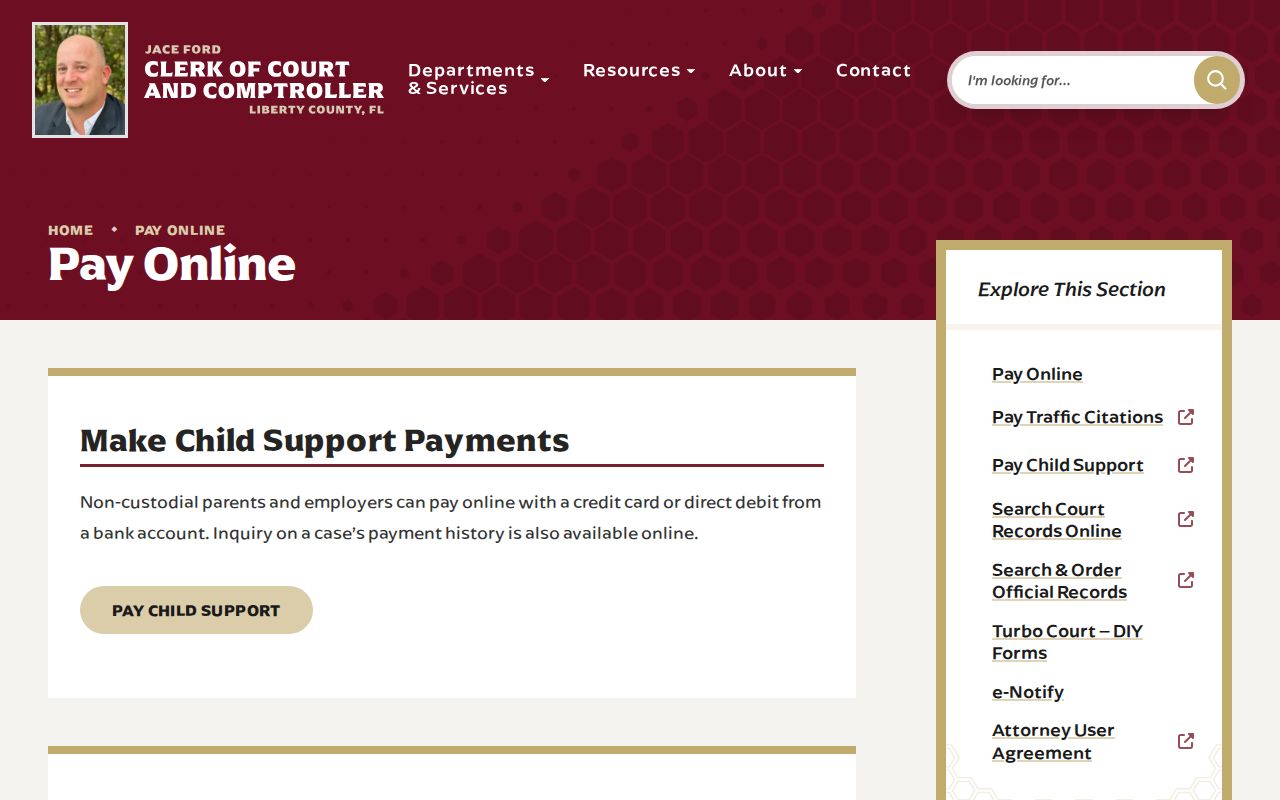
The payment choices help route a known case, but the underlying docket and orders remain the source for the case's meaning.
Capias Events on Liberty Dockets
A public Liberty County docket may show a capias, a court command to take a person into custody. It can follow a failure to appear or another case event, but an old docket entry does not establish that the command remains active. Read later recall, service, bond, and hearing entries together, then confirm current status with the issuing court or Clerk. Never assume that paying an online balance automatically recalls a capias; the court must enter and transmit the proper action.
How a Criminal Case Moves
Booking and prosecution are connected but distinct. After the law-enforcement event, the State Attorney decides what to file. The court then addresses the filed charge, not merely the officer's first label. Motions or negotiated pleas may narrow the issues. A trial may end in an acquittal or verdict, and the final order can be followed by sentencing or later supervision proceedings.
Case flow: Charges Filed › Arraignment › Pretrial › Plea or Trial › Disposition › Sentencing
Each stage can create a separate docket item. First appearance may occur before the formal information is filed. A plea description must be read with the adjudication and sentence. Probation-violation papers may add an affidavit, warrant, hearing, and order to the original file. Liberty County criminal court records should be read through the latest relevant entry, not stopped at the first charge.
Federal Cases Leave Liberty County
A federal criminal matter arising in Liberty County does not become a Liberty Clerk case merely because the event occurred here. Liberty County lies in the Northern District of Florida. Use PACER for federal docket access and the Northern District of Florida for court and filing information. Federal access, sealing, and fees follow federal rules.
The official Northern District source shows the correct court system for federal Liberty County matters.
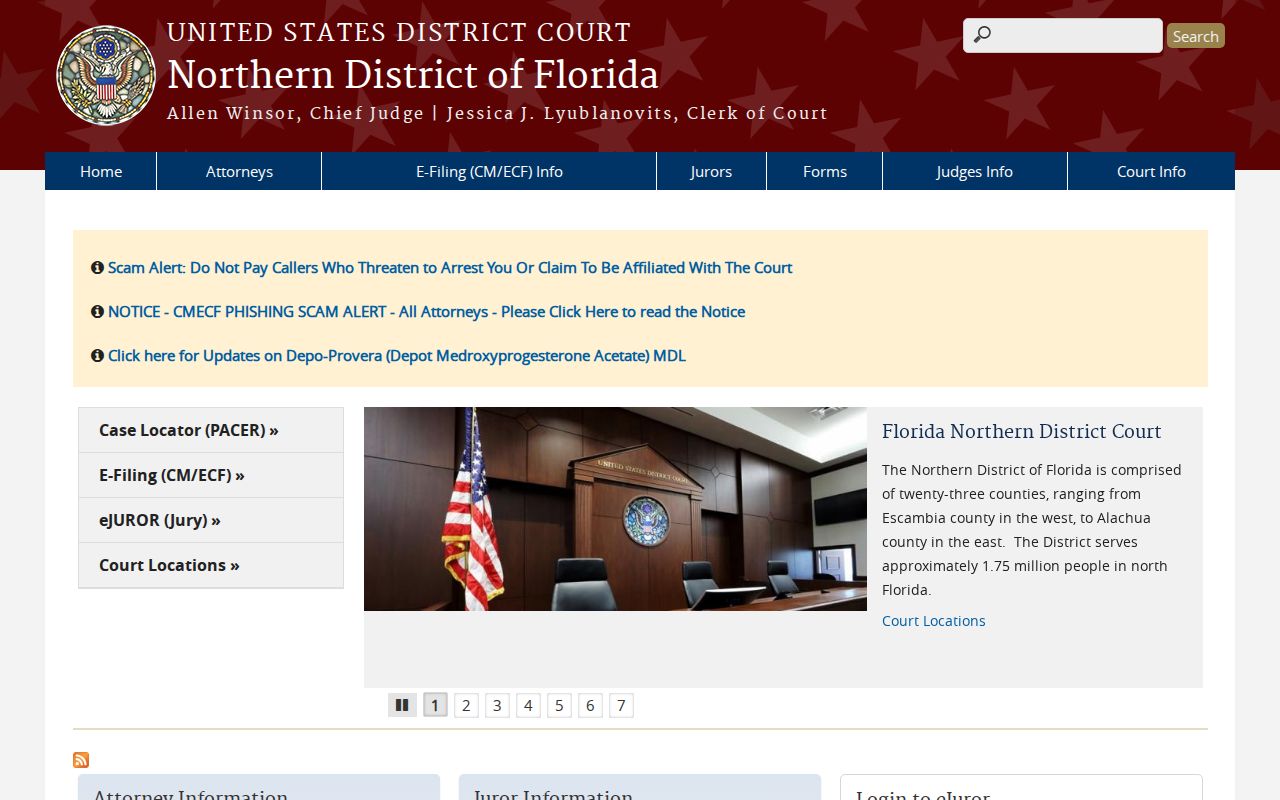
This federal court is separate from Liberty Circuit and County Courts.
PACER requires an account and may assess usage fees. Check its current terms rather than rely on an old fee summary. The official PACER view demonstrates the federal case-access channel.
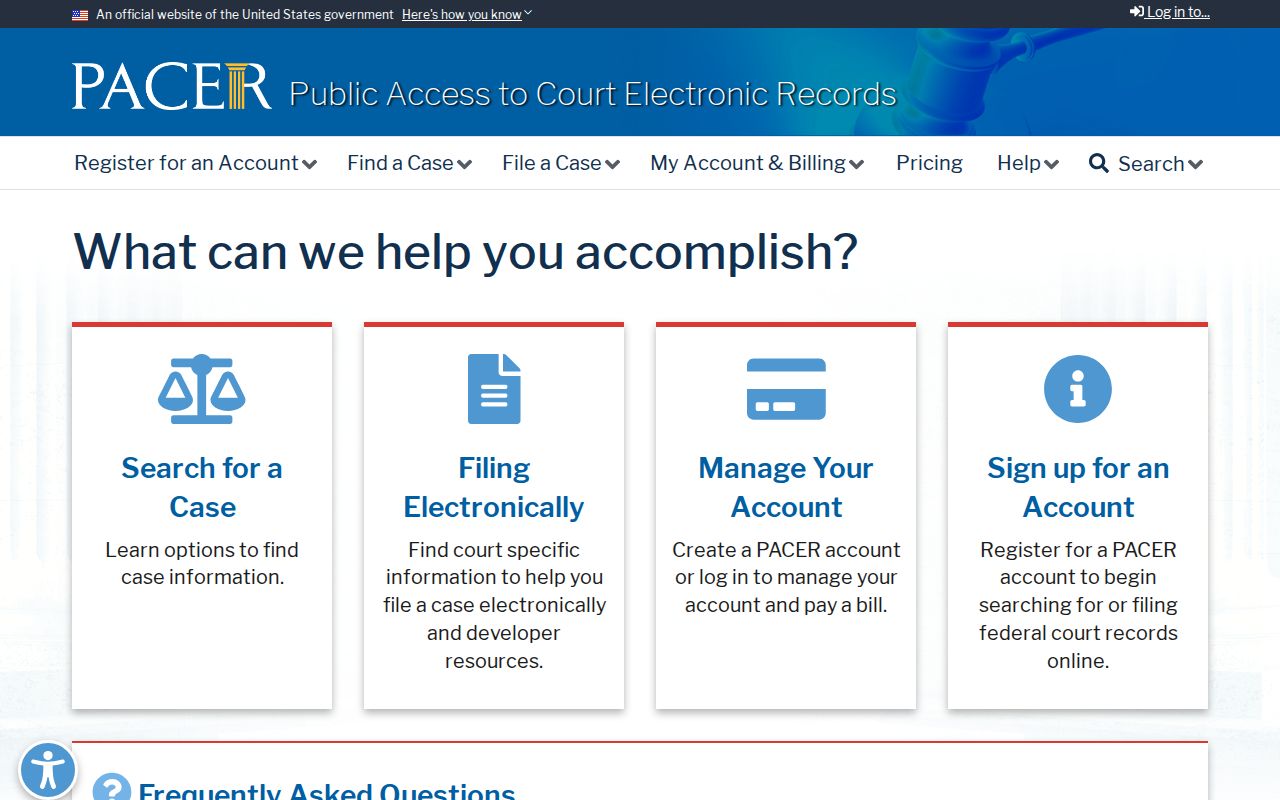
PACER is the proper docket source for federal filings, while the Liberty Clerk remains the proper source for county and state prosecutions.
Case Record Access and Restrictions
Florida starts with a strong public-access principle. Article I, section 24 of the Florida Constitution and chapter 119, Florida Statutes, support access to public records, but judicial records also follow court rules and administrative orders. Online access can be narrower than courthouse inspection. Juvenile information, protected victim data, personal identifiers, medical material, active confidential content, and security-sensitive information may be withheld or redacted.
Properly sealed or expunged information is confidential under sections 943.0585 and 943.059. A requester may not defeat a court order by trying another public office. If a Liberty County case does not appear, check spelling and filing timing, then ask the Clerk whether the matter is older, not imaged, confidential, or outside Liberty County. The clerk cannot disclose protected content merely because a person expected an online result.
The Liberty Clerk homepage is the official source for current office information and record service updates. Verify details there before travel.